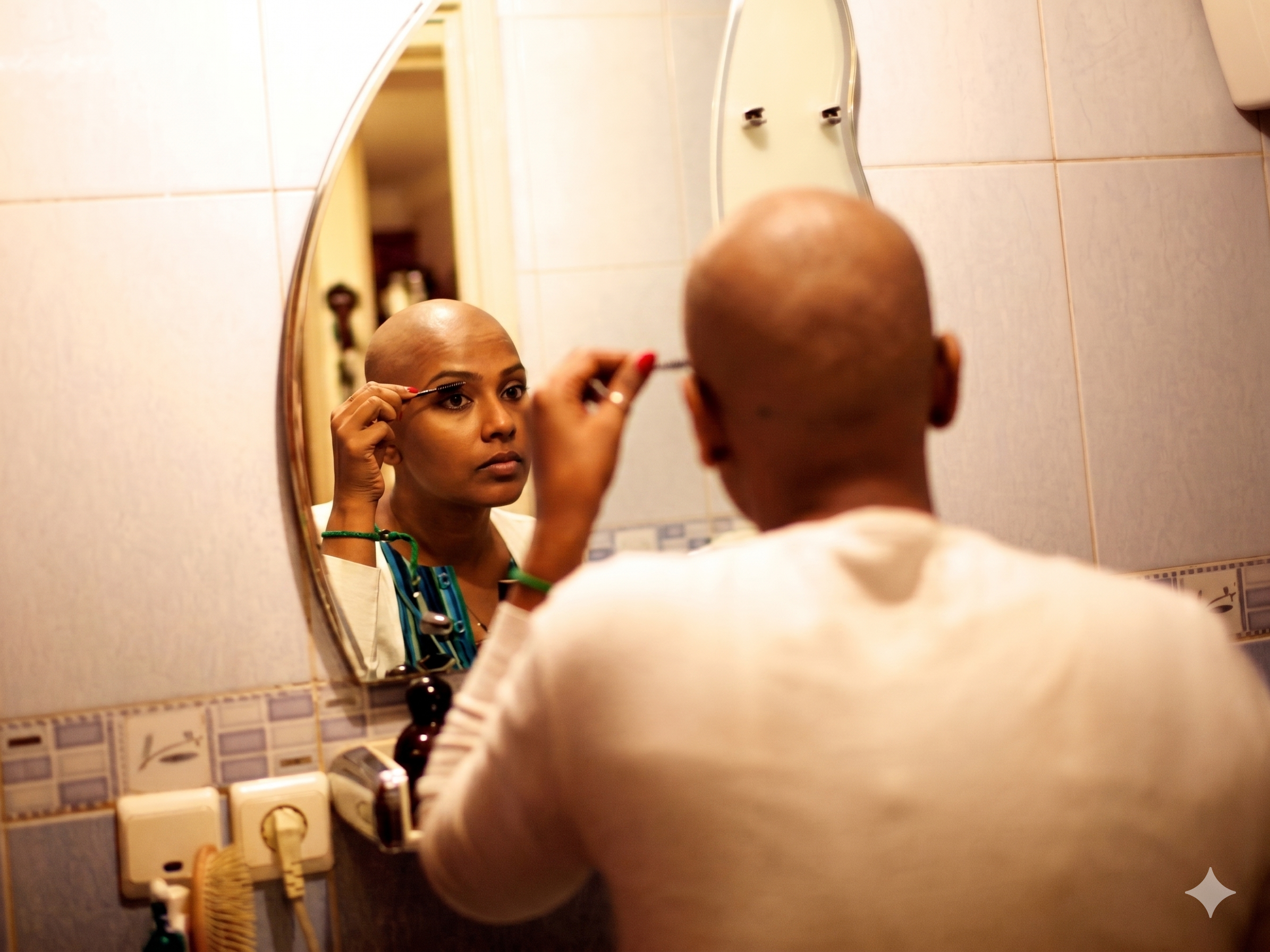
If someone you love has just been diagnosed with breast cancer, there is a particular kind of helplessness that comes with the news. You want to help. You don't know how. You're afraid of saying the wrong thing. You're afraid of saying nothing. This guide is written for the people surrounding a breast cancer patient — partners, parents, adult children, siblings, close friends, colleagues — and is grounded in NHS guidance and the lived experience of women who have been through it.
What 'support' actually means at each stage
Breast cancer is not a single moment but a journey of months — sometimes years. The kind of support that helps in week one is different from the kind that helps in month six. Broadly, the journey divides into four phases: diagnosis, active treatment, end of treatment, and long-term survivorship. Each has its own challenges and its own opportunities to help.
Diagnosis: the hardest two weeks
The two weeks between a suspicious finding and a definitive diagnosis are some of the most psychologically intense in any cancer journey. Most women describe a kind of suspended limbo — unable to plan, unable to fully focus, unable to be reassured. The most useful thing anyone can do during this period is simply be present, without trying to fix anything.
Practical actions that help: offer to come to appointments and take notes, take on a small recurring task (the school run, dog walking, picking up shopping), and resist the urge to research statistics and share them. Most of what you find online is generic; the only data that matters is what the consultant team will share once the diagnosis is confirmed.
Active treatment: the long middle
Active treatment for breast cancer typically lasts six to twelve months, sometimes longer. It might include surgery, several months of chemotherapy, three to six weeks of daily radiotherapy, and the start of long-term hormone or targeted therapies. The cumulative physical and psychological toll is significant, and exhaustion peaks in the second or third month of chemotherapy.
What tends to help most during this phase is reliable, low-effort logistical support. Examples that work consistently:
- Set up a meal train — a shared rota where friends and family deliver pre-cooked meals on a fixed schedule, no need for the patient to coordinate.
- Drive to and from chemotherapy appointments. Treatment days are exhausting and driving home is often unsafe.
- Offer specific, time-bound help: 'I can take the kids to football this Saturday' is more useful than 'let me know if there's anything I can do.'
- Look after the children. Treatment fatigue often affects the ability to parent fully; respite gives the patient real relief.
- Take on small admin: ordering prescriptions, calling the hospital with practical queries, following up on appointment letters.
- Send updates to the wider circle on the patient's behalf, so they don't have to repeat the same news 30 times.
What to say (and what to avoid)
There are no perfect words. The fear of saying the wrong thing often leads people to say nothing — which usually feels worse than even an awkward attempt. A few patterns worth following:
- Acknowledge directly. 'I'm so sorry you're going through this' is better than pretending the diagnosis hasn't happened.
- Listen more than you advise. Most patients have plenty of medical advice from their team; what they often lack is space to talk.
- Avoid 'at least' phrases. 'At least it's caught early' or 'at least you can have reconstruction' tends to land badly.
- Don't share unrequested stories of other people's cancer. Each diagnosis is its own; comparison rarely helps.
- Ask what would be useful, but offer concrete options. 'Would it help if I cooked dinner Tuesday or did the school pickup Thursday?' is easier to answer than 'how can I help?'
- Stay in touch over months, not just at the start. Most patients report a marked drop in support after the first few weeks; the loneliness of months three to six is real.
End of treatment: the surprising hard bit
Many people assume that the end of active treatment is a moment of pure relief. For most patients, it is the opposite. The intense rhythm of appointments stops, the close attention of the medical team eases, and the patient is suddenly left with a body that has been through significant trauma and a future that contains the possibility of recurrence. Anxiety often spikes in the months immediately after treatment ends.
Continued support during this period matters enormously. Friends and family often assume the worst is over and gradually return to normal life — but for the patient, a different kind of recovery is just beginning.
Long-term survivorship
Most women diagnosed with breast cancer in the UK will go on to live for many years — often the rest of a normal life span — but with lasting effects. Long-term hormone therapy can affect bone density, mood and joint health. Lymphoedema can persist after lymph node surgery. Fear of recurrence ebbs and flows for years. Friends and family who continue to acknowledge the experience years later — quietly, without pity — are often the most valued.
Looking after yourself when supporting someone with breast cancer
Supporting someone through a serious illness is exhausting. Carers and close friends frequently experience their own anxiety, sleep disruption and emotional exhaustion. Looking after yourself is not selfish; it is what makes sustained support possible.
Take breaks. Talk to your own GP if you find yourself struggling. Lean on your own friends. Recognise that the energy you have for the patient depends on you having something left to give. The best supporters are not the ones who push themselves to breaking point in week one; they are the ones who can still be there in month nine.
And, finally — the global picture
If you are reading this in the UK, your loved one will receive comprehensive NHS care. That is not the case everywhere. In Indonesia, Pakistan and across South and South-East Asia, most women diagnosed with breast cancer face a treatment journey without the medical, financial or social support that UK patients can expect. If you would like to channel some of the energy that this experience has generated towards women elsewhere, supporting an international charity like Breast Cancer Awareness is one way to honour what your own loved one is going through.
Supporting children when a parent has breast cancer
Children of any age are affected by a parent's breast cancer diagnosis, and they often pick up far more than the adults around them realise. NHS guidance is consistent: children cope better when adults talk openly, age-appropriately and honestly about what is happening, rather than trying to shield them from a reality they can already sense.
For younger children, simple language is usually best — 'Mummy is poorly because of something called cancer, and the doctors are giving her medicine to help her get better'. Avoid euphemisms like 'sleep' that can frighten children. For teenagers, more detailed explanations and the chance to ask questions tend to work well. School staff should be told so that they can offer extra support and watch for changes in behaviour. NHS services and specialist support organisations offer free, age-tailored resources for families navigating this.
When a colleague is the one with breast cancer
Workplace support sits in a category of its own. The patient is your colleague, not necessarily your friend, and there are professional and personal lines to respect. A few principles consistently help.
- Follow the patient's lead on whether and how their diagnosis is discussed at work. Never share their news without permission, even with colleagues who you think will be supportive.
- Offer specific, work-relevant help — covering meetings, taking on a task, joining a difficult call — rather than open-ended 'let me know if you need anything'.
- Respect their preferred working pattern. Some people want to keep working through treatment; others need extended leave. Both are valid and often change over time.
- Keep treating them as a colleague, not as a patient at work. Continue to invite them to meetings, projects and social events even when they cannot always attend.
- Do not ask intrusive medical questions. If they want to talk about their treatment, they will; if they don't, they shouldn't have to.
- Check in occasionally and quietly over months — not just in the first weeks. A short message six months in often matters more than the flurry of support at the start.
Employers also have a role to play. Many UK organisations now have formal cancer-in-the-workplace policies, and NHS-backed guidance is available for line managers and HR teams on supporting a colleague through cancer treatment. If your workplace does not have a policy, suggesting one is itself a meaningful act of support.
One last point that supporters often overlook: looking after yourself. Supporting a partner, parent, sibling or close friend through breast cancer is sustained, demanding work, and the people who do it well are usually the ones who also accept help themselves. Talk to your own GP if your sleep, mood or appetite are suffering. Lean on your wider circle rather than carrying the whole load yourself. Take the time off work that you are entitled to take. Use the NHS carer-support helplines and specialist services available for exactly this purpose. The patient is the focus — but you matter too, and burning out helps no one. Caring well over months and years is a marathon, and the supporters who finish it are the ones who pace themselves from the start.