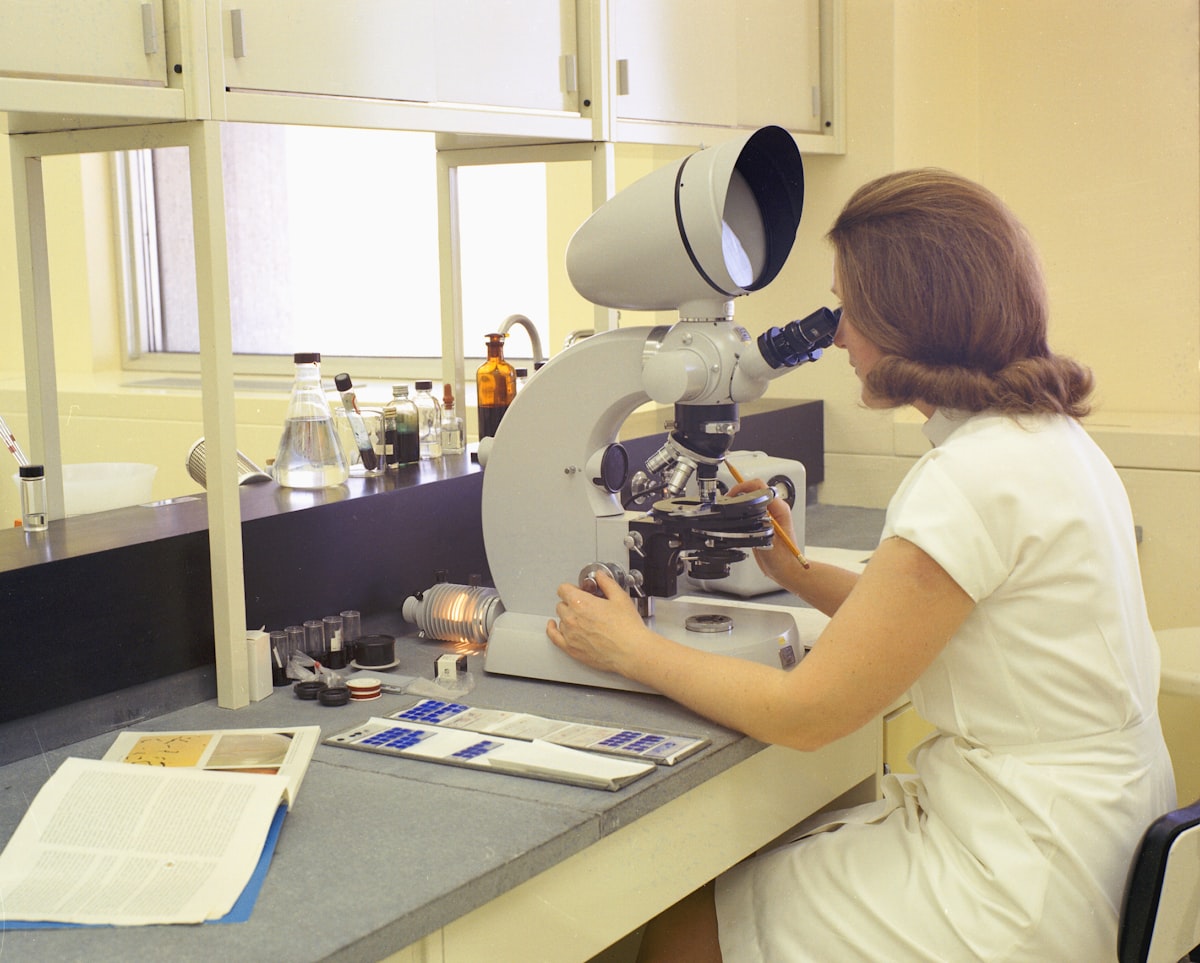
Cancer research and treatment access are often spoken about interchangeably — but they are two fundamentally different things. This article explores the difference between charities that fund scientific research and charities that fund the delivery of treatment to patients who cannot access or afford it. Both kinds of work are essential. They simply answer different questions, operate in different parts of the system, and reach patients at different stages.
Both kinds of work are essential. They simply answer different questions. Understanding the difference is one of the most useful things any thoughtful donor can do.
Research-funding cancer charities: what they do
Research-funding charities give grants to universities, hospital research teams, clinical trial networks and individual scientists. Their primary work is to fund the discovery, development and validation of new treatments, screening methods, diagnostic tools and biological understanding of cancer. The biggest UK research-funding cancer charities — including the well-known one whose name appears in the title of this post — are among the largest funders of cancer research in Europe.
The achievements of this kind of charity over the past 50 years are extraordinary. Many of the chemotherapy regimens, targeted drugs and screening tools that have transformed survival from breast, colorectal, prostate and other cancers were developed with support from research-funding charities. The trade-off — inherent to research, not a flaw — is that the time horizon is long and the link between any individual donation and a clinical benefit is indirect.
Treatment-access cancer charities: what they do
Treatment-access charities take the treatments and screening methods that research has already proven and work to make sure they reach the people who need them. Within the UK, this might mean filling gaps that the NHS does not cover — patient transport, financial grants, complementary therapies, peer support. Internationally, it usually means funding the basic infrastructure of cancer care in countries where it is missing or out of reach: mobile screening clinics, diagnostic equipment, subsidised treatment access, community health worker training.
Breast Cancer Awareness is a treatment-access charity working internationally. Our funded programmes in Indonesia, Pakistan and across South and South-East Asia bring breast cancer screening, diagnosis and treatment to women who would otherwise go without. We do not fund laboratory research. We do not run UK patient services. Our work begins where research-funding work ends — at the point of clinical delivery.
Why both are needed
It is tempting, when comparing two kinds of charity, to ask which is 'better'. The honest answer is that they are not in competition. Research charities produce the treatments. Access charities make sure the treatments reach women who need them. The progress of the past 50 years has come from both, and the work of the next 50 will require both.
What changes over time is the balance of where the marginal benefit per pound is largest. In the 1980s and 1990s, when many of today's standard treatments did not yet exist, research-funding work was arguably the highest-leverage place to give. In 2026, with a substantial back-catalogue of proven interventions and a global mortality picture concentrated in countries that lack access to them, the marginal-benefit case for treatment-access work has strengthened considerably — at least for diseases like breast cancer where the survival gap between rich and poor countries is enormous.
How to choose between them
The right charity for you to support depends on what you want your donation to do. Some questions that help clarify the choice:
- Do I want my money to fund the discovery of new treatments, or the delivery of existing ones?
- Am I willing to wait years to see clinical impact, or do I want my donation to fund care that happens this year?
- Do I want my impact to be focused on the UK, on low-income countries, or both?
- Am I optimising for the most lives saved per pound, or for proximity to a cause that touches my own family?
- Do I trust the charity to spend wisely if I give unrestricted, or would I prefer to fund a specific programme?
There is no single right answer. There is, however, a wrong way to give: choosing a charity based purely on brand recognition, without understanding what your donation will fund. That is the mistake this article is meant to help prevent — whichever side of the research/access question your eventual choice falls on.
Why the research/access framing matters for breast cancer specifically
Breast cancer is one of the diseases where the research vs access distinction matters most. The science is well advanced — UK survival is 87%, the highest it has ever been. The global picture is starkly different — 670,000 deaths a year, the great majority in countries with little organised breast cancer care. The greatest concentration of preventable death is not in the science but in the implementation gap.
This is not an argument against breast cancer research; the case for continued investment is strong. It is an argument for treating treatment access as the equally important sibling of research, not as an afterthought.
Where Breast Cancer Awareness sits — and why we are upfront about it
Breast Cancer Awareness is, transparently, a treatment-access charity. We are not a research-funding charity. We do not pretend to be. If you are looking to support breast cancer research, your donation should go to a research-funding charity, of which there are several excellent UK options. If you are looking to support international access to breast cancer screening and treatment for women in the world's poorest places, we hope you will consider us.
We are deliberately direct about this because the alternative — vague positioning that gestures at everything — is what makes it hard for thoughtful donors to give well. The cancer charity sector is at its strongest when each charity is clear about what it does, donors choose deliberately, and the result is funding flowing where it actually matches each donor's intent. That is what we hope this guide contributes to, regardless of which charity ends up benefiting.
How research-funding organisations compare with each other
Several UK organisations fund breast cancer research, each with a different focus. Some are large, broad-based funders covering all cancer types. Others focus specifically on breast cancer — funding laboratory research, clinical trials, patient information services or helplines. Still others concentrate on early-stage discovery science, aiming to identify new treatment targets before clinical development begins.
The UK also has breast cancer-specific research institutions and university departments that conduct much of their own work, as well as internationally focused organisations that fund research in lower-income settings where the infrastructure for clinical trials is still developing.
Smaller, focused research organisations — including those specialising in particular cancer subtypes, hereditary cancer syndromes or metastatic disease — fill gaps that larger funders sometimes overlook. A donor who cares about a specific question (BRCA, triple-negative breast cancer, secondary breast cancer) can often achieve more impact by giving to a focused organisation than a generalist one. The Charity Commission register makes it straightforward to find and verify registered UK charities.
Where treatment-access charities fit in alongside research
Research and treatment access are sometimes presented as competing priorities. They are not. They are complementary parts of the same overall picture: research discovers what works, and access ensures that what works actually reaches people. A breakthrough drug developed in Cambridge does not save lives in Karachi until someone has built the supply chain, trained the clinicians and funded the patient subsidies that allow it to be prescribed there.
For UK donors thinking about how to split their giving, a reasonable rule of thumb is to fund both — the proportion depending on whether you are more drawn to long-term scientific progress or to the more immediate, measurable impact of getting proven interventions to people who need them now. There is no right answer, only the answer that matches your own values. Either way, the worst outcome is donating from default rather than from intent.
If you are still deciding, a useful exercise is to write down — in a single sentence — what you most want your giving to achieve. 'I want to help find a cure within my lifetime' points clearly toward research-funding charities. 'I want my money to save a specific person's life this year' points clearly toward treatment-access charities. 'I want to make sure UK patients get the best possible care' points toward patient-support charities. Most donors find that even the act of articulating the sentence is clarifying — and that whichever charity they then choose, they give more confidently and more consistently as a result. That confidence and consistency is, in the end, what funds the work.