Breast cancer is the most commonly diagnosed cancer in the United Kingdom. Around 56,000 new cases are recorded each year — the equivalent of one diagnosis every nine minutes — and approximately 11,500 women die from the disease annually. This guide pulls together the current NHS and Office for National Statistics data to give a clear picture of where breast cancer in the UK stands in 2026.
Incidence: how common is breast cancer in the UK?
About 1 in 7 women in the UK will be diagnosed with breast cancer at some point in their lifetime. The risk increases sharply with age. Around 80% of breast cancer cases occur in women over the age of 50. Around 1 in 5 cases — about 11,000 a year — occur in women under 50, and a small number occur in men (approximately 400 cases a year in the UK).
Incidence has risen modestly over the past two decades. This is driven partly by an ageing population, partly by improved detection through screening, and partly by changes in lifestyle and reproductive patterns (later first pregnancies, later menopause, and rising rates of obesity).
Survival: where the UK stands
Survival from breast cancer in the UK has improved dramatically over the past 50 years. In the 1970s, around half of women diagnosed with breast cancer survived for five years or more. By 2026, that figure is approximately 87%. Around 76% of women diagnosed with breast cancer in the UK survive for ten years or more.
Survival depends heavily on stage at diagnosis. The NHS reports approximate 5-year survival figures of 99% for Stage I, 90% for Stage II, 70% for Stage III and 28% for Stage IV breast cancer. This is why screening and prompt presentation to a GP matter so much: the same disease has very different outcomes depending on how early it is caught.
The NHS Breast Screening Programme
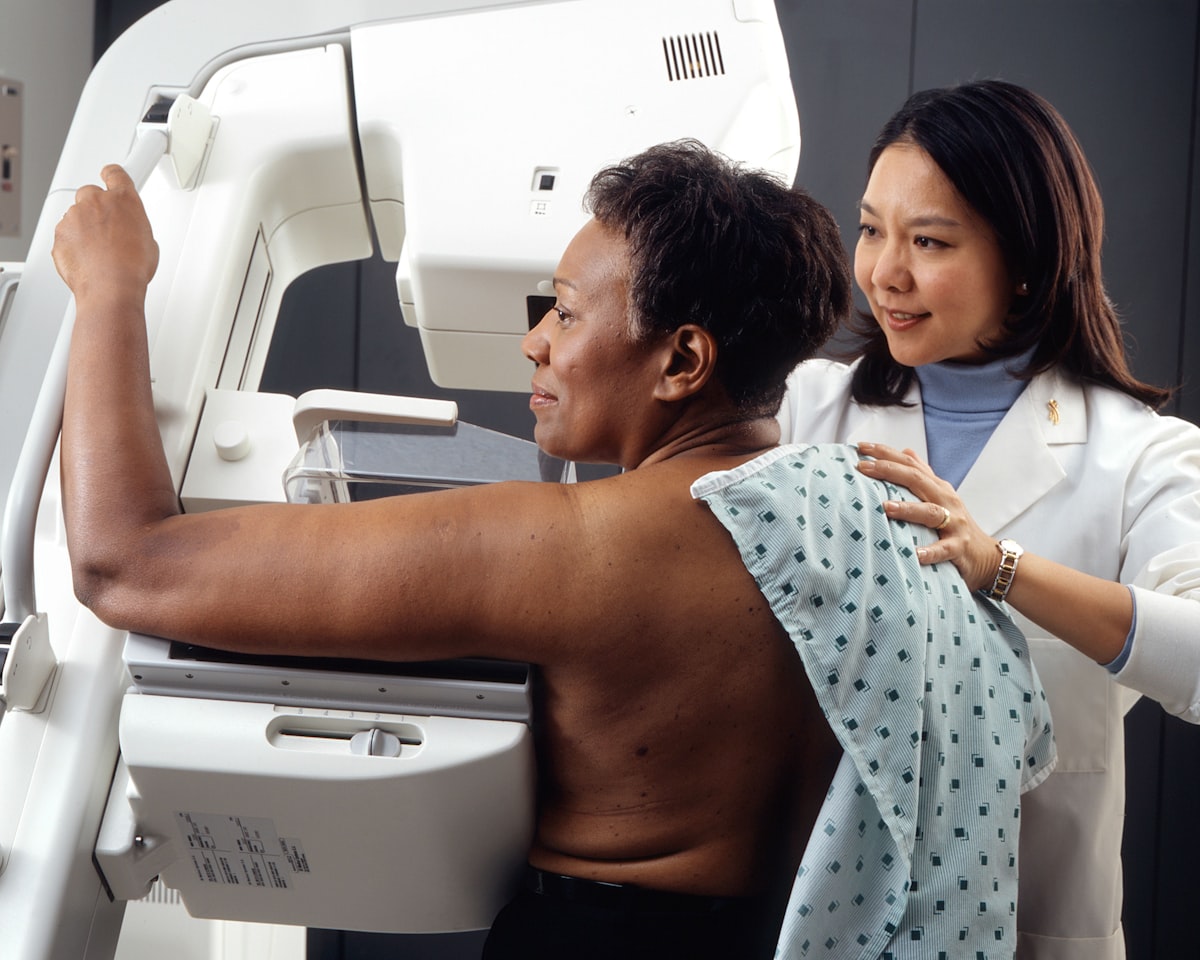
The NHS Breast Screening Programme was introduced in 1988 and is one of the largest organised cancer screening programmes in the world. Every woman registered with a GP in the UK is automatically invited for a mammogram every three years between the ages of 50 and 71. A trial extension is currently inviting women aged 47–73 in some areas.
Around 2 million women are screened in the UK each year. Approximately 4 in every 1,000 women screened are diagnosed with breast cancer as a result. Modelling studies estimate that the programme prevents around 1,300 breast cancer deaths in the UK every year — although it does also detect some cancers that would never have caused harm in a woman's lifetime, a phenomenon known as overdiagnosis.
Treatment access in the UK
The NHS provides comprehensive breast cancer treatment free at the point of need. The two-week-wait pathway means that any woman referred urgently by her GP for suspected breast cancer should be seen by a specialist within 14 days. The triple assessment (clinical examination, imaging, biopsy) is usually completed in a single visit, and a definitive diagnosis is typically reached within a fortnight of referral.
Treatment is delivered by multidisciplinary teams that include breast surgeons, oncologists, breast care nurses and psychologists. The full spectrum of modern treatments — surgery (lumpectomy or mastectomy), radiotherapy, chemotherapy, hormone therapy, targeted drugs such as trastuzumab, and immunotherapy for some triple-negative cancers — is available through the NHS, although waiting times and access to newer drugs can vary by region.
Inequalities within the UK picture
The headline UK figures hide significant inequalities. Women from more deprived backgrounds are more likely to be diagnosed at a later stage, less likely to attend screening, and more likely to die from breast cancer than women from less deprived areas. Black women in the UK are diagnosed at younger ages on average and have lower 5-year survival than white women, partly due to higher rates of triple-negative breast cancer and partly due to delays in presentation and diagnosis.
South Asian women in the UK have historically had lower screening uptake, often linked to language barriers, cultural factors and lack of community-level outreach. NHS England has identified narrowing these gaps as a strategic priority for the second half of this decade.
What comes next: AI screening, blood tests and prevention
Three changes are likely to reshape UK breast cancer care over the next decade. First, AI-assisted mammogram reading is being trialled to improve sensitivity and reduce radiologist workload. Second, blood-based liquid biopsies may eventually allow earlier detection of recurrence. Third, more women at high inherited risk (particularly BRCA1 and BRCA2 carriers) are accessing risk-reducing surgery and intensive surveillance, lowering their lifetime risk.
These developments will likely improve UK survival further. They will not, on their own, change the global picture — which is why charities like ours focus on extending the same standard of care to women in countries where it does not yet exist.
The UK in global context
UK breast cancer outcomes are among the best in the world. They are not yet the best — Australia, Sweden and the United States all report slightly higher 5-year survival figures. But the gap between the UK and high-income peers is small. The gap between the UK and Indonesia, Pakistan, Bangladesh and other parts of South and South-East Asia is enormous: 87% vs 35–45% 5-year survival.
That gap is not biological. The biology of breast cancer is the same everywhere. The gap is one of access — to screening, to diagnosis, to treatment. Closing it is the work of the next decade. It is the work Breast Cancer Awareness exists to do.
Inequalities within the UK picture
Headline UK survival figures conceal real and persistent inequalities. Women from the most deprived fifth of the UK population are diagnosed at later stages and have worse 5-year survival than women from the least deprived fifth — a gap of around 5–8 percentage points, depending on the year and dataset. The reasons are familiar from public health research: lower screening attendance, longer presentation times to a GP, less continuity of care, and a higher prevalence of co-morbidities.
Ethnicity also matters. NHS and Public Health England data have consistently shown that British South Asian and British Black women present at later stages on average than British White women. The reasons are complex — including cultural attitudes to screening, language barriers, lower awareness of NHS screening invitations, and structural factors in primary care — but the consequences are measurable. The NHS has invested in culturally tailored outreach programmes, and several UK breast cancer charities run targeted awareness work in these communities.
Geography matters too. Regional analyses of cancer survival across the UK have consistently shown modest variation, with women in some parts of the North East and Wales experiencing slightly worse outcomes than women in London and the South East. Closing these gaps — within the UK as well as globally — is a core focus for NHS England, the Department of Health and Social Care, and the broader cancer charity sector.
What patients can expect from NHS breast cancer care in 2026
If you or someone you know is diagnosed with breast cancer in the UK, the NHS pathway is generally well-defined. After a referral from a GP for a suspected breast lump or screening recall, you should be seen by a specialist breast clinic within two weeks under the NHS cancer waiting time standards. The first appointment will typically include a clinical examination, imaging (mammogram and ultrasound) and, where warranted, a needle biopsy on the same day — the so-called 'one-stop' clinic.
If breast cancer is confirmed, the case is discussed at a multi-disciplinary team (MDT) meeting bringing together breast surgeons, oncologists, radiologists, pathologists and specialist nurses. A treatment plan — typically combining surgery, radiotherapy, chemotherapy, hormone therapy or targeted therapy depending on the cancer type — is then agreed with the patient. NHS standards aim for treatment to start within 31 days of the decision to treat, and within 62 days of GP referral.
Throughout this process, every NHS patient is assigned a clinical nurse specialist (CNS) — usually a breast care nurse — who acts as a single point of contact. This role is one of the most consistently appreciated features of UK breast cancer care, and it is something that women navigating fragmented systems elsewhere often have no equivalent of.
Looking across all of these elements together — the NHS Breast Screening Programme, the two-week wait pathway, the multi-disciplinary team model, the breast care nurse role, and the steady decade-on-decade improvement in survival — the overall picture for breast cancer in the UK in 2026 is one of a system that is broadly working well, while still grappling with real and persistent inequalities. The headline UK performance is among the best in the world. The job from here is partly continuing to improve that headline, and partly making sure the women who currently fall outside it — by deprivation, ethnicity, geography, or chance — are no longer left behind.