Breast cancer screening is the systematic use of mammography in women without symptoms to find cancer at the earliest possible stage — when it is small, has not yet spread, and is most treatable. The NHS Breast Screening Programme is one of the most successful organised cancer screening programmes in the world, and is responsible, by NHS estimates, for preventing approximately 1,300 breast cancer deaths in the UK every year.
This guide covers everything you need to know about breast cancer screening as it operates today: what it is, how it works, who is invited, what happens at an appointment, what the results mean, and how to think about screening if you are outside the routine programme. It is the primary post in our breast cancer screening cluster — the deeper companion posts cover when to start mammograms and screening for women over 70.
What breast cancer screening is
Breast cancer screening uses tests on women who do not have any symptoms in order to find disease at the earliest possible stage. The standard test in the UK is mammography — a low-dose X-ray that produces detailed images of the inside of each breast. Modern mammography machines use digital imaging, which gives clearer pictures, lower radiation doses and faster processing than the older film-based systems.
Screening is not the same as a diagnostic test. A screening mammogram does not by itself diagnose breast cancer; it identifies areas that need further investigation, which is then carried out at a specialist breast clinic.
Who is invited for NHS breast screening
In the UK, all women registered with a GP are automatically invited for breast screening every three years between the ages of 50 and 71. The first invitation arrives by post sometime between your 50th and 53rd birthday — there is no need to register, you will simply be contacted. A trial extension is currently inviting women aged 47–73 in some areas, with the aim of evaluating whether routine screening should be expanded across these wider age bands.
Women over 71 are not invited automatically but can request screening every three years by contacting their local screening unit. Women under 50 are not routinely screened because the benefits of screening at younger ages are smaller and the radiation exposure from repeated mammograms in younger women is a more significant consideration. However, women at very high inherited risk (for example, BRCA1 or BRCA2 carriers) are screened from a younger age under specialist NHS surveillance programmes.
What happens at a breast screening appointment
An NHS breast screening appointment typically takes around 30 minutes from arrival to leaving. The mammogram itself takes only a few minutes. Here is what to expect:
- Arrival and check-in. You will be asked to confirm your details and answer a short medical questionnaire.
- Undressing from the waist up. You will be given a hospital gown to wear.
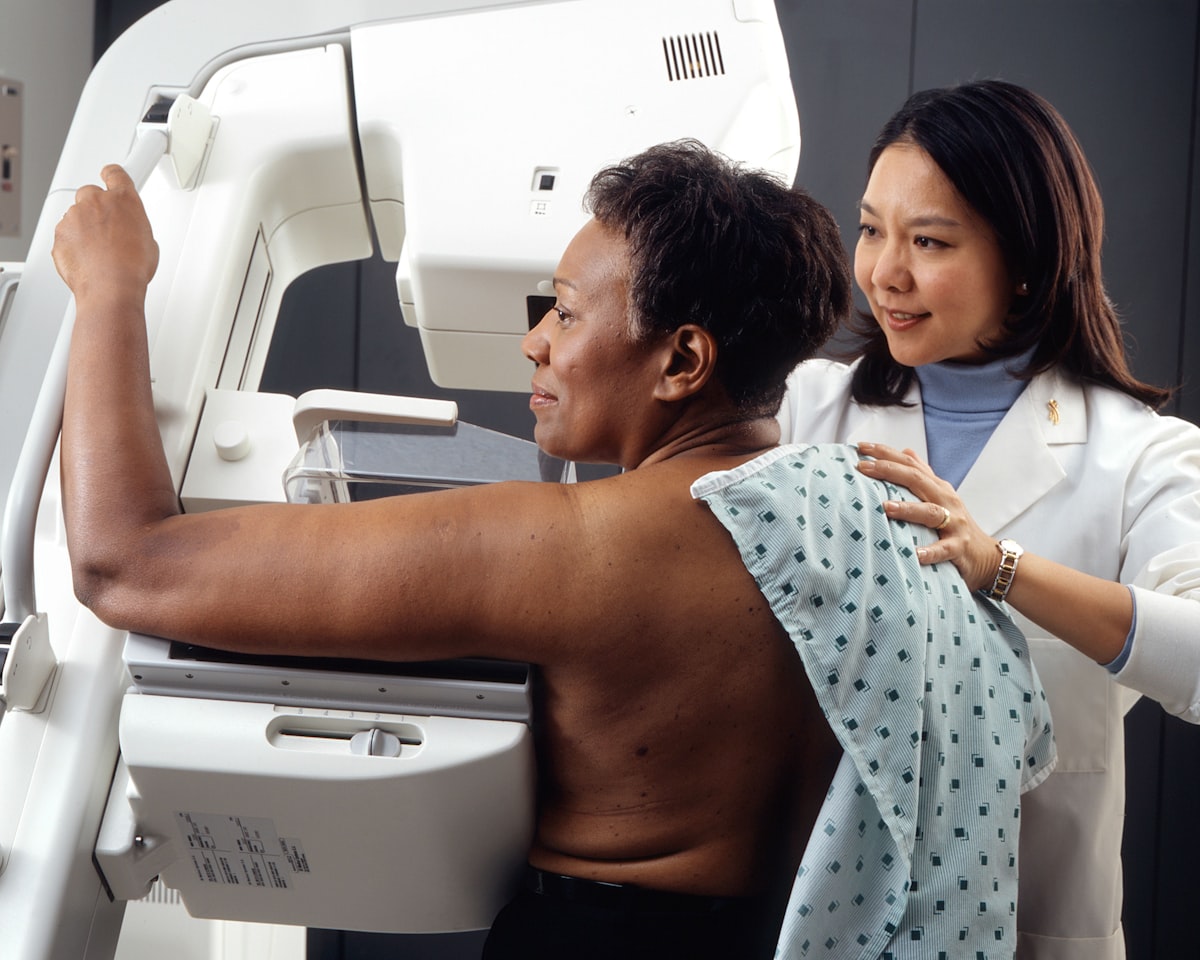
- The mammogram. A specialist female radiographer will help you position one breast at a time on the mammogram machine. Each breast is gently compressed between two flat plates while the X-ray image is taken. Two views are usually taken of each breast.
- Compression. The compression of the breast is necessary to spread the tissue evenly and produce a clear image. It can be uncomfortable for a few seconds but is not usually painful. The compression lasts only as long as the image is taken.
- Dressing and departure. Once both breasts have been imaged, you can dress and leave. Results are sent to you by post within two weeks.
What your results mean
There are three possible outcomes from a screening mammogram, and most women receive the first.
The first is a normal result. This means the radiologists who reviewed your images saw nothing of concern. Approximately 96 in every 100 women screened receive this result. You will be invited again in three years' time.
The second is a result requiring further assessment. This means something on the image needs a closer look. Approximately 4 in every 100 women screened are recalled for further assessment. The vast majority of these turn out not to have cancer — a recall does not mean you have cancer. Further assessment usually involves additional mammogram views, an ultrasound and, where needed, a needle biopsy. Most recalled women get a clear result and are returned to routine screening.
The third is a confirmed cancer diagnosis. Of women recalled for further assessment, approximately 1 in 5 turns out to have breast cancer. This works out to approximately 8 cancers detected per 1,000 women screened. If cancer is detected, you will be referred quickly to the breast clinic to discuss treatment options.
Benefits and limitations of screening
Screening is highly effective at finding breast cancer earlier than it would otherwise be detected — and earlier detection is the single largest driver of better survival. NHS modelling suggests the UK programme prevents approximately 1,300 deaths a year. For most invited women, attending screening is one of the highest-impact health decisions they can make.
Screening does have limitations, which the NHS is open about. Some cancers grow between screening rounds (interval cancers) and are not detected by the programme. Some women are recalled for further investigation that turns out not to be cancer — known as a false positive — which causes anxiety. And some cancers detected through screening would never have caused harm during a woman's lifetime — a phenomenon known as overdiagnosis. The NHS estimates that for every life saved, around three women are diagnosed with a cancer that would not have caused them harm. On balance, the benefits substantially outweigh the harms for the screened age group, but the picture is more nuanced than 'screening is always good'.
Screening if you are at higher risk
Women at higher-than-average risk of breast cancer — for example, those with a strong family history, a known BRCA1 or BRCA2 gene mutation, or a previous diagnosis of breast cancer — are usually offered enhanced surveillance under specialist NHS programmes. This may include earlier and more frequent mammograms, MRI scans (which are more sensitive in younger women with dense breast tissue), and clinical examinations by a breast specialist.
If you have a family history of breast or ovarian cancer that worries you, ask your GP for a referral to a family history clinic for risk assessment. The threshold for genetic testing has been progressively widened in the NHS over recent years.
Screening between appointments — Touch, Look, Check
Screening is one half of breast cancer awareness; the other half is being breast aware between appointments. Around 1 in 3 breast cancers in the UK is found between scheduled screenings — usually because a woman or her partner notices a change. The NHS recommends knowing what is normal for your breasts and checking regularly using the simple Touch, Look, Check method described in our about-breast-cancer guide.
Screening and self-checking work together: one finds cancers that have not yet produced symptoms, the other finds cancers that have. Both matter. Both save lives.
Screening in the global context
The NHS Breast Screening Programme is a remarkable public health achievement, but it is not the global norm. In Indonesia, Pakistan, Bangladesh and across South and South-East Asia, organised national screening programmes do not yet exist or reach only a small minority of eligible women. The result is that most breast cancers in these countries are diagnosed at Stage III or IV — when survival is dramatically lower.
Closing this gap is the work that Breast Cancer Awareness exists to do. Mobile screening clinics, community health worker training and subsidised diagnostic and treatment access, all funded by donor support, are gradually extending the kind of early detection benefit that the UK has had for nearly 40 years to women whose lives currently depend on whether they happen to live in a country with such a programme.
Practical preparation for your screening appointment
A few simple steps can make your NHS breast screening appointment quicker and more comfortable. The NHS guidance is consistent and worth following.
- Wear a two-piece outfit. You will need to remove your top half for the mammogram, so a separate top and trousers or skirt is more practical than a dress.
- Avoid using deodorant, talcum powder, perfume or moisturiser on your underarms or breasts on the day. Some products can show up as small spots on the mammogram and lead to unnecessary recall.
- Bring a list of any medicines you take, particularly hormone replacement therapy, and a note of any breast symptoms you have noticed.
- If you have breast implants, mention this when you book or arrive — the radiographer may use a slightly different technique to image around them.
- If you are pregnant or breastfeeding, let the screening service know in advance. Routine screening is usually delayed in these circumstances.
- Allow about 30 minutes for the appointment, although the mammogram itself takes only a few minutes per breast.
Most women describe the mammogram as briefly uncomfortable rather than painful. If you have particular concerns — about pain, anxiety, language, mobility or any disability — tell the screening service when you book and they will adjust the appointment accordingly. NHS screening services are very used to making reasonable adjustments, and asking is always welcome.