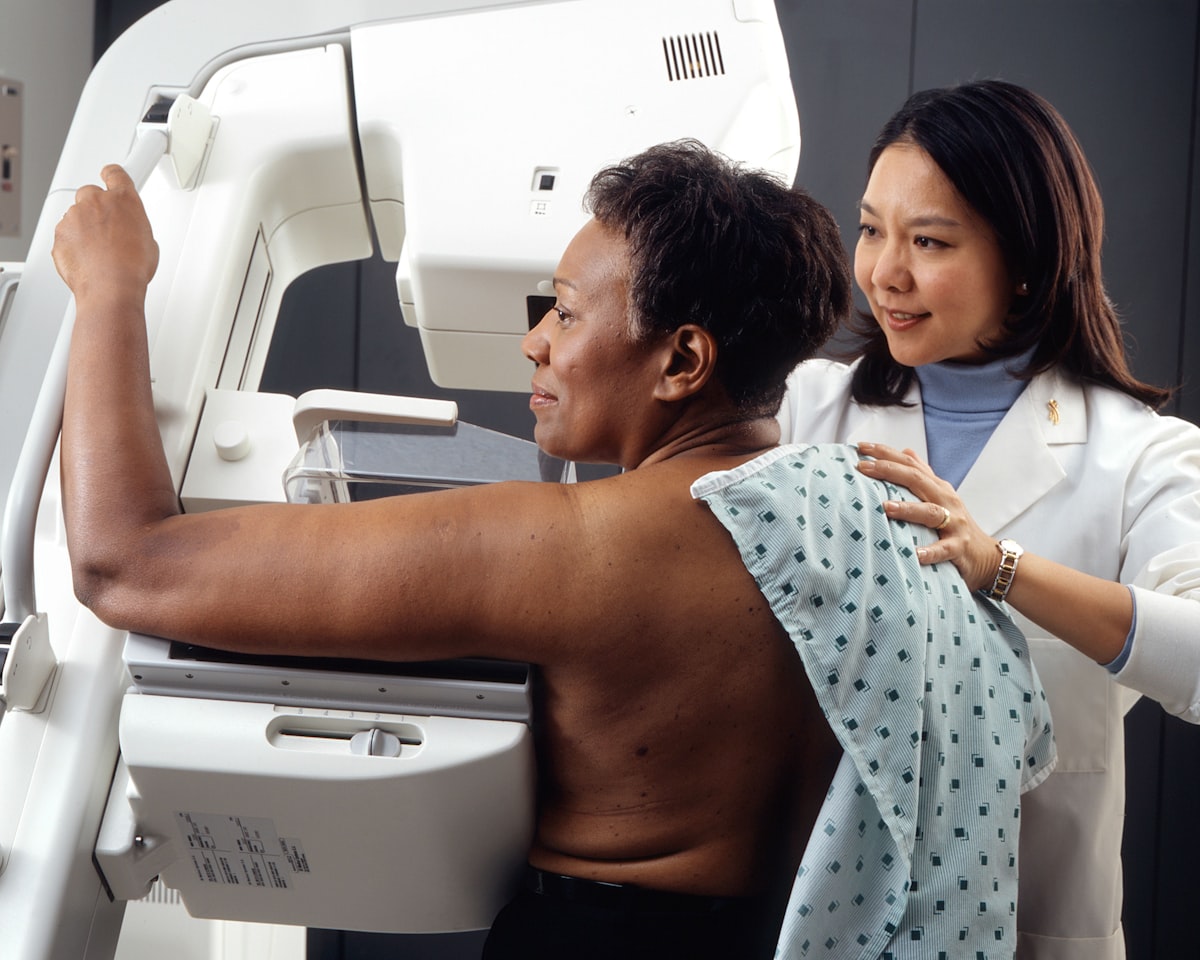
One of the most common questions women in their thirties and forties ask their GPs is: when should I start having mammograms? The answer is more nuanced than the headline figure suggests. For most women, routine NHS screening starts at age 50. For some — those with a strong family history, a known genetic mutation, or other higher-risk profiles — earlier surveillance is offered. Knowing where you fit in matters.
This guide explains, in plain English, when mammograms start in the UK, who is eligible for earlier screening, what to do if you're worried about your risk, and what the alternatives to mammography are for younger women whose dense breast tissue makes mammograms less informative. It is part of our breast cancer screening cluster of guides; for the broader picture, read our complete plain-English guide to breast cancer screening.
What the NHS recommends as standard
The standard NHS recommendation is that women aged 50 to 71 are invited for a mammogram every three years through the NHS Breast Screening Programme. The first invitation arrives by post sometime between your 50th and 53rd birthday — there is no need to register or ask. If you are between these ages and have not received your first invitation, contact your GP or local breast screening unit.
A trial extension is currently inviting women aged 47–73 in some areas. The aim is to evaluate whether routine screening should be expanded permanently across these wider age bands. If you live in a trial area, you may be invited up to three years earlier than the standard 50.
Why screening starts at 50 — not earlier
The decision to start routine screening at 50 reflects a careful balance between benefits and harms. In women under 50, breast cancer is rarer, breast tissue is denser (which makes mammograms harder to interpret), and the cumulative radiation exposure from repeated screening over decades carries a small but real risk. Together, these mean that the benefit-to-harm ratio of routine mammography is less favourable in younger women than in those over 50.
This does not mean breast cancer in women under 50 is not a real concern. Around 1 in 5 UK breast cancers — about 11,000 a year — are diagnosed in women under 50. But the way to find these cancers earlier is largely through awareness, prompt presentation to a GP, and targeted surveillance for higher-risk groups, rather than through universal mammography of the under-50 population.
When earlier screening is offered
There are several circumstances in which the NHS offers mammograms (and sometimes additional MRI screening) earlier than the standard age of 50.
- Known BRCA1 or BRCA2 gene mutations. Women carrying these mutations are typically offered annual surveillance from age 30, including MRI scans (which are more sensitive than mammograms in younger women with dense tissue) and mammograms from age 40.
- Other known high-risk gene mutations such as TP53 (Li-Fraumeni syndrome) or PALB2. Surveillance protocols vary; specialist genetics clinics will advise.
- Strong family history without a known gene mutation. NHS family-history risk assessment criteria look at the number, age and relationship of relatives with breast or ovarian cancer. Women assessed as moderate or high risk may be offered earlier surveillance.
- Previous radiotherapy to the chest before age 30 (for example, for childhood cancer). Annual MRI surveillance is usually offered from 8 years after radiotherapy or from age 25, whichever is later.
- Previous diagnosis of breast cancer. Women who have had breast cancer are offered annual mammograms for at least five years after their initial diagnosis, often longer.
How to find out if you are at higher risk
If you have a family history of breast or ovarian cancer that worries you, the first step is to talk to your GP. They will take a detailed family history and, if appropriate, refer you to a family history clinic or specialist genetics service for a formal risk assessment. The thresholds for genetic testing have been progressively widened in the NHS over recent years; you may be eligible even if you would not have qualified five years ago.
What counts as a notable family history? In broad terms, the more relatives affected, the closer they are to you, and the younger they were at diagnosis, the more significant the family history. A mother diagnosed in her 40s, two sisters with breast cancer, or any relative with both breast and ovarian cancer are all flags worth raising with your GP.
What about private mammograms before 50?
Private breast screening is available in the UK and some women in their forties choose to have private mammograms. Whether this is worthwhile depends on your individual risk profile. For women at average risk, the evidence base for routine private screening below 50 is weaker than the NHS recommendation suggests is justified. For women at elevated risk who do not yet meet NHS thresholds for high-risk surveillance, private screening may be more clearly beneficial.
If you are considering private screening, discuss it with your GP first. They can help you assess whether your risk profile genuinely warrants earlier mammograms, and whether ultrasound or MRI might be a more useful initial test for your circumstances.
What to do between mammograms — at any age
Whatever your screening status, being breast aware matters at every age. The NHS recommends knowing what is normal for your breasts and checking them regularly using the simple Touch, Look, Check method. Around 1 in 3 UK breast cancers are found between scheduled screenings — usually because a woman notices a change.
If you notice any change — a new lump, skin dimpling, nipple inversion, discharge, or persistent pain — see your GP within a week or two. The two-week-wait pathway means that any GP referral for suspected breast cancer is seen by a specialist within 14 days. Most referrals turn out not to be cancer; the point of the rapid pathway is to give the small minority who do have cancer the best possible chance of early treatment.
If you are over 50 and have not been invited
If you are between 50 and 71, are registered with a UK GP, and have not received an invitation for breast screening, do not wait. Contact your GP or your local breast screening unit. You may have been missed because of a registration mismatch, an address change, or a delay in the local screening rota.
The same applies if you are over 71 and would like to continue being screened. You will not be invited automatically, but you have the right to request screening every three years by contacting your local unit directly. Our companion guide to breast screening for women over 70 covers this in more detail.
What to do between mammograms
Mammograms catch most breast cancers, but not all of them — and three years is a long gap. The single most important thing women can do between screening appointments is to be breast aware: knowing how their breasts normally look and feel, and noticing changes early.
The NHS recommends the Touch–Look–Check method, which is not a formal self-examination but a habit of awareness during everyday activities — in the shower, when getting dressed, applying moisturiser, or after exercise. The NHS guidance lists the changes worth contacting a GP about: a new lump or thickening anywhere in the breast or armpit, a change in the size or shape of the breast, dimpling or puckering of the skin, redness or rash, nipple discharge other than breast milk, a nipple that has become inverted when it was not before, or persistent pain in one specific area. Most of these turn out to be benign — but they should always be checked.
If your routine NHS screening is not due for two more years and you notice any of the above, do not wait for the next mammogram. Book a GP appointment. The NHS two-week wait pathway exists for exactly this reason — and most women referred under it turn out not to have cancer, which is the system working as intended.
International perspective: screening ages around the world
Different high-income countries set their breast screening age ranges slightly differently. The US recommendation, updated by the US Preventive Services Task Force in 2024, now starts routine mammography at age 40. Australia and Canada start at 50, similar to the UK, although both offer self-referred screening from age 40. Sweden starts at 40 in some regions and 50 in others. The European Commission's 2022 update to its breast cancer screening guidance recommended extending invitation ranges to ages 45–74 across EU member states.
These differences reflect genuine scientific debate about where the harm-benefit balance sits — not certainty in any direction. The UK position is currently at the older, more cautious end of that range, but the trial extension to 47–73 in some areas suggests the UK system is open to revising the case for earlier and later screening as new evidence accumulates. Watch this space over the next few years.